ConnXL
Designing the product layer between enterprise data and the spreadsheets people already work in.
Excel remains deeply embedded in how companies analyze information, operate processes and make decisions. ConnXL was conceived to reduce the technical distance between those spreadsheets and the APIs, databases and infrastructure where enterprise data actually lives.
- Organization
- Innmotrix
- Year
- 2026
The ConnXL workspace
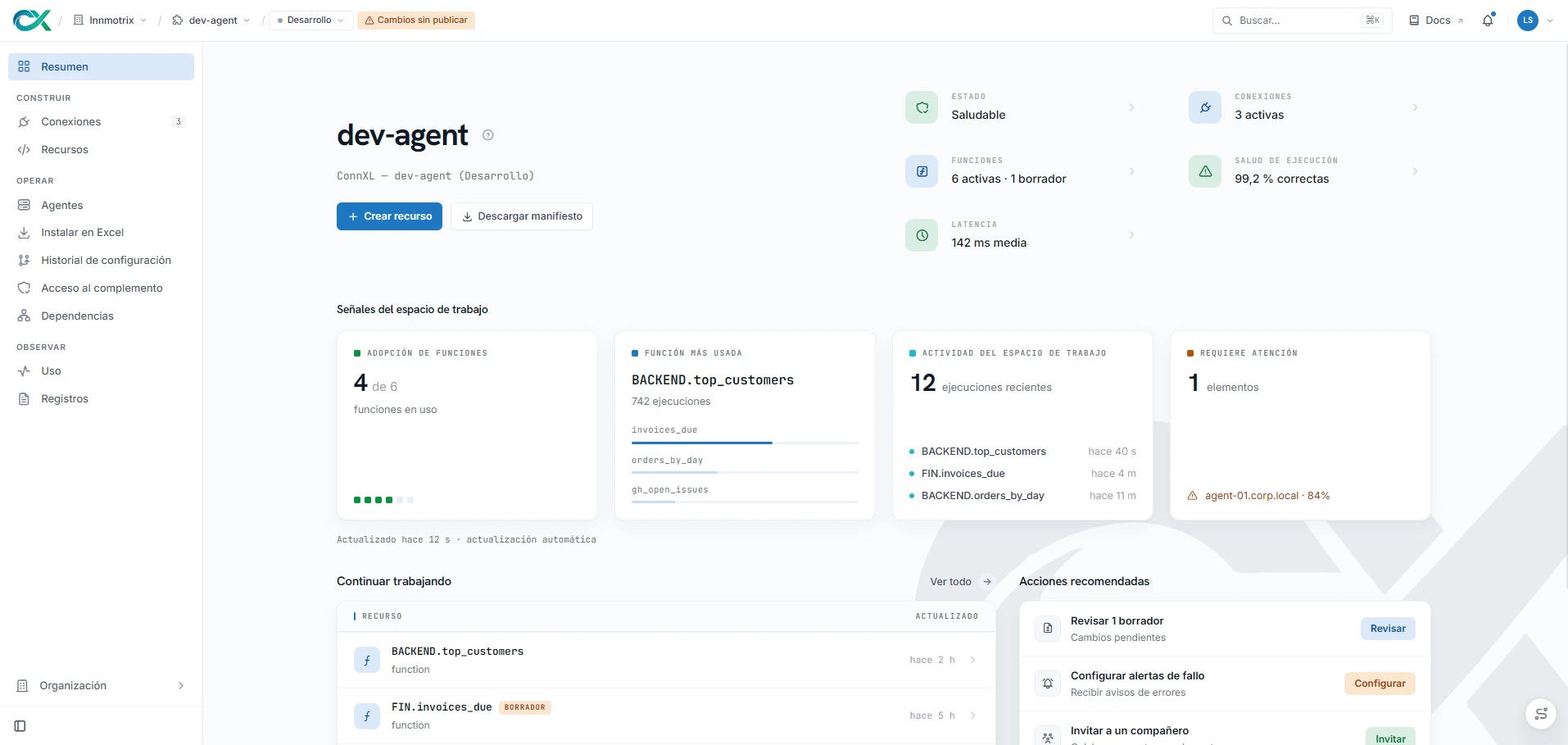
A workspace centralizes the connections, resources, agents and operational signals required to build and maintain connected Excel experiences.
01 The product problem
Excel remained the interface. The complexity lived behind it.
Many organizations still rely on Excel as a critical interface for analysis and operations, while their data lives across APIs, databases and internal systems.
Connecting those worlds typically requires custom development, technical configuration and ongoing maintenance for each use case.
ConnXL emerged around a product question: how could those capabilities be built and managed as reusable resources without transferring all that complexity to the Excel user?
02 Product model
Turning technical infrastructure into a product model
The platform had to be understood before it could be used. Rather than exposing infrastructure directly, ConnXL organizes technical capability into four product concepts that always relate to each other in the same order.
Each concept is one decision, and each one only makes sense because of the one before it. That chain is the mental model the whole product is built on.
-
Data source
API, database or enterprise system.
-
Connection
Defines how ConnXL communicates with that source.
-
Resource
Transforms the connection into something Excel can use.
-
Excel
The resulting function or experience becomes available where the user already works.
How a capability comes into being
03 Abstraction
Making configurable what normally requires development
One of the main design challenges was representing technical concepts without turning ConnXL into an interface designed exclusively for developers.
Connections, parameters, authentication, functions, environments and execution behavior needed enough depth for real enterprise scenarios while maintaining a consistent structure that made their relationships understandable.
The solution was not to hide complexity, but to organize it progressively: surface the decisions required first and expose additional configuration when the resource actually needs it.
What had to stay configurable
- Connections
- Parameters
- Authentication
- Environments
- Execution
04 Product system
Designing a system, not isolated screens
ConnXL brings together objects with very different purposes: connections, resources, functions, parameters, environments, permissions and execution. The design challenge was preventing each capability from becoming an independent experience.
The interface needed to share a recognizable logic across modules: how something is configured, what state it is in, where it belongs and what can be done with it. That consistency allows the product to grow without forcing users to learn a different model every time a new capability appears.
01 02
05 The Excel loop
The product ends where the user already works
All of the configuration work exists so complexity can disappear at the moment of use.
Once published, a capability can become a function or experience available directly inside Excel. For the person consuming the result, the infrastructure, authentication and logic behind it no longer need to be the center of the interaction.
That was one of ConnXL's fundamental principles: move complexity into configuration so consumption can remain simple.
06 Design principles
Principles for designing a technical product without making it cryptic
- 01
Progressive complexity
Expose only the complexity required for the current task.
- 02
Consistent models
Different objects should share recognizable patterns for configuration and state.
- 03
Flexibility without fragmentation
Support different configurations without turning every case into a different experience.
- 04
Separate configuration from consumption
Technical complexity belongs in configuration; the result should remain simple to use.
07 Outcome
A product layer between enterprise systems and Excel
ConnXL turns technical infrastructure into capabilities that can be configured, governed and reused through a common product model.
The design work was in defining that model: deciding which complexity needed to be exposed, maintaining consistency across different capabilities and ensuring everything ultimately reached the person consuming the result through a familiar interface: Excel.